

On this page
- 1. Check the drain hose for kinks and clogs
- 2. Look at the standpipe and the house drain
- 3. Clean the drain filter on a front-load washer
- 4. Rule out an overloaded or unbalanced drum
- 5. Listen for the drain pump
- 6. Read the error code on the display
- 7. When to stop and call a technician
- 8. How to keep it from happening again
What is the short answer?
Run 6 checks in about 15 minutes before you call: the drain hose for kinks, the standpipe for a backup, the drain filter on a front-load washer, the load for weight, the pump for a hum, and the display for a drain code. If water still sits in the drum, the pump or a switch needs a technician.
A washer full of dirty water is a bad way to start laundry day. The good news is that drain faults come down to a short list of causes, and you can rule out the first few without tools or a service call.
Before you start, unplug the washer. Water and electricity don't mix, and the drain parts sit low in the cabinet where spills collect. Keep towels and a shallow baking tray close by, because more water comes out of a hose or filter than you'd expect once you open it.
This guide walks through six checks in the order that saves the most time, starting with the ones that cost nothing. It covers top-load and front-load washers, and says where the two differ.
1. Check the drain hose for kinks and clogs
Pull the washer forward far enough to see the back panel. The drain hose is the corrugated tube that runs from the washer to the wall. A hose squeezed against the wall or folded behind the cabinet is a common reason a washer drains slowly, and it takes a minute to check.
Straighten any kink you find. If the hose looks clear, disconnect it from the standpipe, hold the open end over a bucket and run a short drain cycle. A slow trickle or a plug of lint means the hose needs clearing or replacing.
Check the hose height too. Every washer has a maximum height for the top of the drain loop, and it's listed in the owner's manual. A hose looped higher than that makes the pump work against gravity, and the drum empties slowly or not at all.
2. Look at the standpipe and the house drain
The standpipe is the vertical pipe in the wall that the drain hose sits in. If it's clogged, the washer can be perfectly healthy and still won't empty.
Here's a quick test. Pour a bucket of water into the standpipe, or run the laundry sink if you have one next to it. If the water backs up or drains slowly, the blockage is in the house drain, and a plumber will fix it faster than a washer technician can.
If the standpipe takes the water without a fuss, the house plumbing is fine and the fault is inside the washer. Move on to the next check.
3. Clean the drain filter on a front-load washer
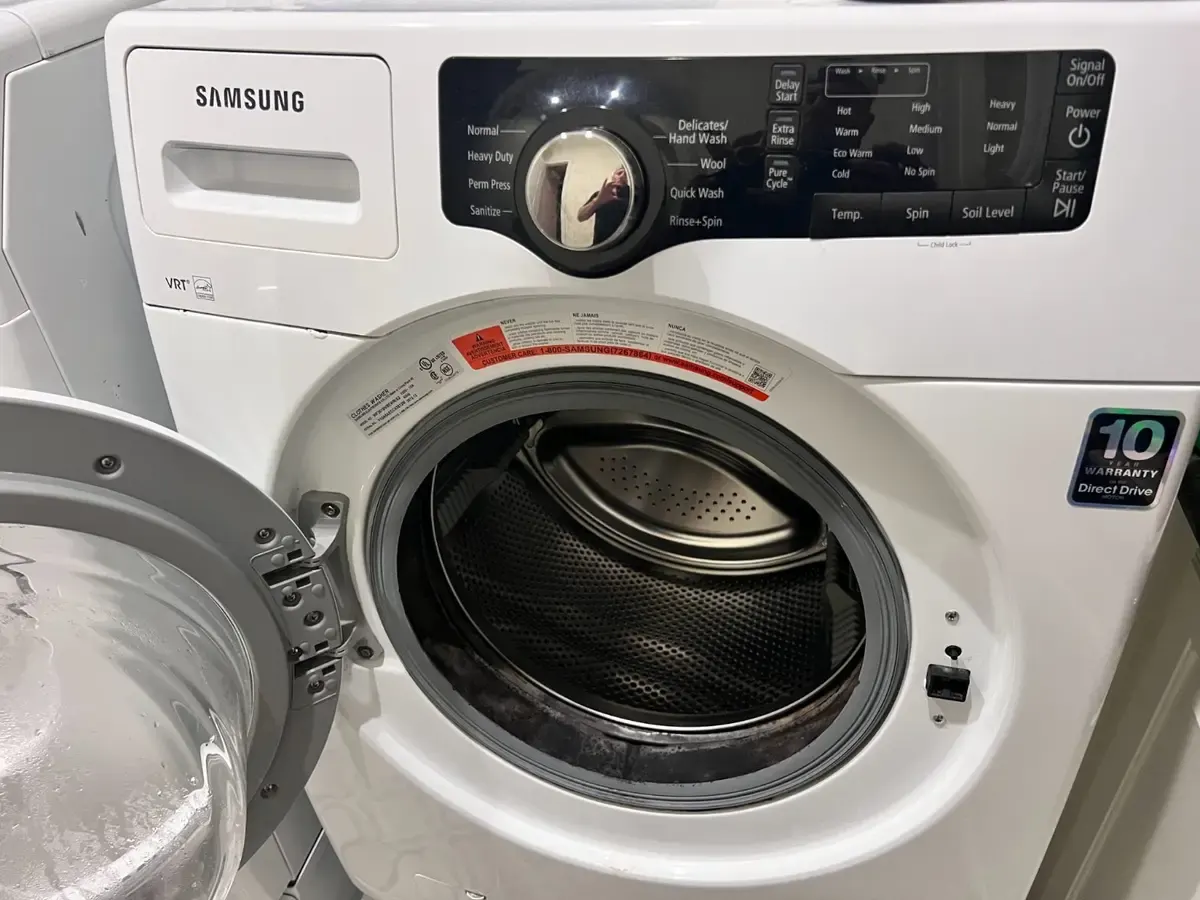
Most front-load washers have a drain filter, sometimes called a coin trap, behind a small panel at the bottom front. It catches the things that slip out of pockets before they reach the pump: coins, buttons, hair ties, socks and lint.
Put the baking tray and towels under the panel, then open the filter slowly. Water will run out, so let it drain before you turn the filter all the way out. Pull out anything stuck in the filter, rinse it and screw it back in until it's snug.
Many top-load washers don't have a filter you can reach. Check your manual, and if yours doesn't list one, move on to the next check.
4. Rule out an overloaded or unbalanced drum
A drum packed with towels or bedding holds a lot of water, and an unbalanced load can make the washer pause the spin and leave water in the tub. This is the easiest fault to fix, so it's worth a quick look before you go deeper.
Take half the load out, spread the rest evenly and run the drain and spin cycle on its own. If the drum empties, the machine is fine and the load was the problem. Wash heavy items in smaller loads from now on.
5. Listen for the drain pump
Plug the washer back in, then run the drain or spin cycle and listen. What you hear tells you where the fault is.
- A hum with no water moving means the pump is running but something is jamming it, often a sock or a coin.
- A grinding or rattling sound points to a foreign object inside the pump housing.
- Silence means the pump isn't getting power, which could be the pump motor, a wiring fault or the control board.
On a top-load washer, a worn lid switch can also stop the cycle, because the machine won't run while it thinks the lid is open. On a Samsung top-load washer in Spanish Fork, a faulty lid lock switch assembly was the fault, and the old part showed signs of burning or electrical failure.
6. Read the error code on the display
Most modern washers show a code when the drain fails. Samsung washers often show 5E or SE, and LG washers show OE. Other brands use their own codes, so check the manual for the exact meaning on your model.
A drain code confirms the washer knows the water isn't leaving, but it doesn't say why. If you've cleared the hose, the standpipe, the filter and the load and the code returns, the pump or its wiring is the next suspect.
7. When to stop and call a technician
Stop and book a repair if any of these happen:
- Water is still in the drum after checks 1 to 4.
- The pump hums or grinds and moves no water.
- You smell something burning, or you see scorched wiring.
- The washer leaks from the base, the door or the hoses.
- The drain code comes back after a reset.
Don't keep running a washer that won't drain. Standing water leaves a smell, and a jammed pump that keeps trying to run can burn out the motor.
A visit starts with a diagnosis, so you know the fault before you decide anything. Repairs cost $150 to $1,000, depending on the fault, the part and the model. We repair top-load and front-load washers from Samsung, LG, Whirlpool, Maytag, GE, Bosch and other brands in Orem, Lehi, Provo, Spanish Fork and West Jordan.
8. How to keep it from happening again
Most drain faults start in a pocket. Check pockets before every wash, and put small items like socks and hair ties in a mesh bag.
Clean the drain filter if your washer has one. Leave the door or lid open between washes so the drum dries out, and don't pack the drum so full that clothes can't move.
If a drain fault keeps returning, something deeper is wrong, and it's better to find it early than after the pump fails.
Common questions
Can a washer drain without the pump working?
No. The drain pump is the part that moves water out of the drum. Some water can run out through the hose by gravity, but a washer with a dead pump leaves water in the tub and won't finish a cycle.
Is it safe to run a washer that won't drain?
No. Stop the washer and unplug it. A jammed pump that keeps trying to run can burn out its motor, and standing water in the tub starts to smell.
How much does it cost to fix a washer that won't drain?
Repairs cost $150 to $1,000, depending on the fault, the part and the model. A clogged filter or hose is a simpler fix than a failed pump or control board, and the diagnosis tells you which one you have.
Do you repair both front-load and top-load washers?
Yes. We repair top-load and front-load washers in Orem, Lehi, Provo, Spanish Fork and West Jordan, from brands including Samsung, LG, Whirlpool, Maytag, GE and Bosch.